The Background
MuteScale is an app that is designed to work alongside a physical scale that produces positive affirmations when stepped on instead of showing the user’s weight. Our client came up with this idea when she was struggling with an eating disorder, and part of her disordered thinking included compulsively checking her weight. She struggled to stop checking even if she hid away her scale, and wanted to create a way to go through the process of weighing herself without the trigger of a number. The app will be capable of providing users with affirmations while they are away from their scale, as long as provide other mental wellness activities such as mood tracking and guided meditation.
This project presented the unique challenge of designing a product that I didn’t fully understand. It’s called a scale, but it doesn’t do the one thing that a scale is supposed to do (measure weight). It was essentially a mental health app with extra steps. I had no idea what the scale was supposed to do, and frankly, I still don’t, but I was able to still create a prototype that the client was happy with.
Additionally, I learned how to use components to make more dynamic and realistic prototypes. I wanted the user to be able to select their mood while interacting with the prototype, and I learned how to utilize components in Figma, which made me realize that, up to this point, I had been designing with one hand tied behind my back.
The Process
Competitive Analysis
The client asked for MuteScale to include many features that are already available in other apps. We completed a competitive analysis of these other apps to see if there was a market gap for this product. We found that while there were many apps that included some features that we planned to incorporate into MuteScale, no app had all of the features, and most required a subscription for users to fully benefit. Since the MuteScale app is going to either be free or require a one time payment, we determined that it would make sense to include the features that were not entirely unique to MuteScale. The results of the competitive analysis can be seen below.
Requirements Gathering & Information Architecture
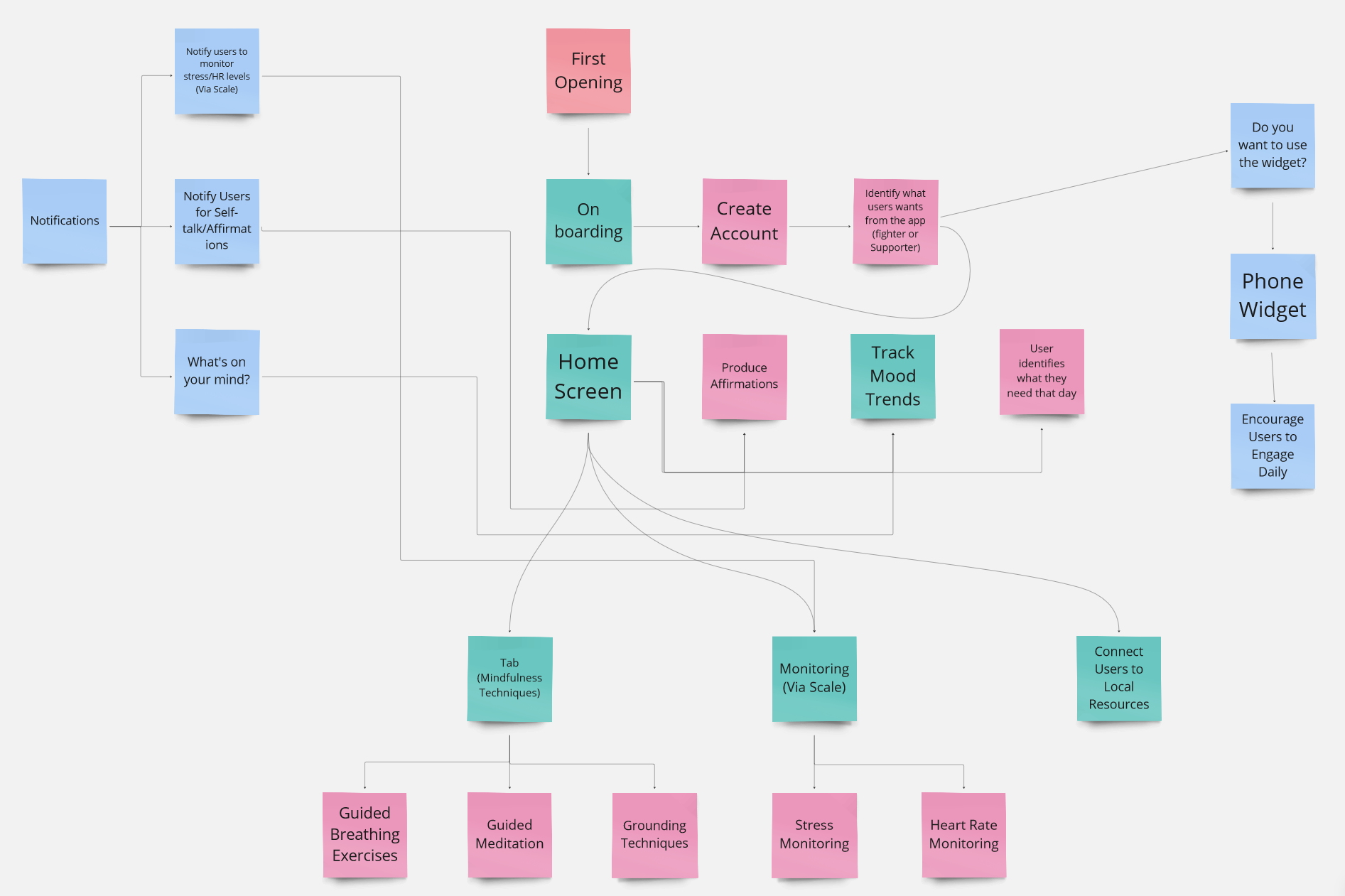
After it was determined that there was a gap in the market, a MoSCoW analysis was completed on the list of requirements with the client to determine what features would be needed for an MVP. The results of the analysis were then organized into an IA, which is shown below.